Mauritius offers foreign buyers freehold title, no capital gains tax and residency for the family — but the right location depends entirely on what you want from the island. A practical guide to the north, west, south and centre, with what each area costs in late 2026.
Mauritius has quietly become one of the most practical places in the world for a foreign buyer to own property. Not because it is cheap, because it is not, but because the rules are clear, the title is freehold, and the purchase can carry a residence permit for your whole family. This guide sets out what you can buy, where, and what it genuinely costs.
Why foreign buyers choose Mauritius
The tax position is the starting point. Mauritius charges no capital gains tax on property, no inheritance tax, and a flat 15% income tax that applies to individuals and companies alike. When you sell, the gain is yours. When you pass the property to your children, it goes to them without an estate bill.
The second reason is residency. An investment of USD 375,000 or more in an approved scheme — PDS, IRS, RES or Smart City — qualifies you for a residence permit, which extends to your partner and your children under 18. The permit is tied to the property: you hold it for as long as you own the home, and it ends if you sell. It is a residence permit rather than permanent residency, and it carries no automatic right to citizenship.
A word on rental yields, because this is where buyers are most often misled. Gross rental yields in Mauritius typically run between 2.5% and 4%. That is respectable, but it is not spectacular, and it is well below what some advertising suggests. If you are buying purely for rental income, there are better markets in the world. If you are buying for capital appreciation, a tax-free exit and somewhere to actually live, Mauritius is very hard to beat.
The north: the busiest market, and the easiest to let
The north is the island's most developed coastline and the simplest place to rent a property out. Grand Baie is its commercial heart, with restaurants, a marina, international schools and the largest expatriate community on the island. Asking prices through late 2026 put the Grand Baie median around Rs 27 million, at roughly Rs 190,000 per square metre.
Pereybère, ten minutes further north, is the value entry point. It is predominantly an apartment market, and at around Rs 89,000 per square metre it is the cheapest square metre of the main coastal areas — less than half what Grand Baie commands, for a beach many people prefer. We currently market two developments here: Ocean 16, with apartments from Rs 14.5 million, and Celestine, a small ten-unit residence at Rs 22 million.
Trou aux Biches is the quieter northern alternative, known for one of the island's best swimming beaches and a calmer, more residential feel than Grand Baie. The Sand Private Residences sits here, priced at Rs 24.5 million.
For buyers who would rather build than buy finished, North Calodyn offers serviced building plots from Rs 5.5 million — the most accessible entry point in our portfolio, and a route many people overlook.
The west: sunsets, mountains and the island's highest prices
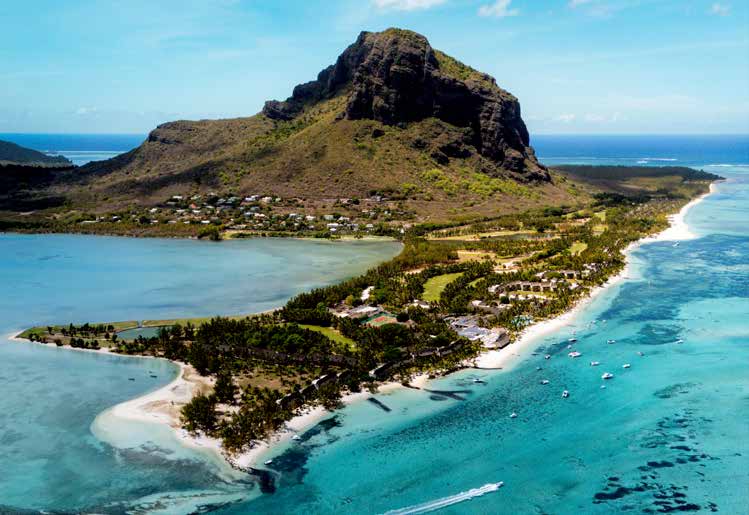
The west coast runs from Flic en Flac down through Tamarin to Black River, and it is where the island's most expensive property sits. Black River records the highest price per square metre of any major area, around Rs 260,000, with a median asking price near Rs 77 million. You are paying for the mountain backdrop, the dolphins, and some of the best sunsets in the Indian Ocean.
The Peninsula at Les Salines is our flagship in this area, with villas from USD 2.4 million to USD 4 million. It is the kind of address that sells itself to buyers who already know the west coast.
Flic en Flac offers the same coastline at a more approachable level, with a long public beach and a growing cluster of development around Medine Smart City. Bijou Résidence sits in that scheme, with apartments, penthouses and villas from USD 400,000 to USD 1.4 million. For a buyer targeting the USD 375,000 residency threshold, this is one of the most direct routes to it.
The south: the island as it used to be
The south is the least developed coast and, for a certain buyer, the most appealing. There are no crowds, the landscape is dramatic, and the fishing villages still function as fishing villages.
Domaine d'Anbalaba at Baie du Cap is the standout here. It is an IRS estate spanning more than 15 secured hectares between the Morne Brabant and the ocean, and it took both Best Mixed-Use Development Africa and Best Sustainable Residential Development Africa at the 2024–2025 African Property Awards. It offers bioclimatic Nomadic Villas designed to stay comfortable without air conditioning, serviced building plots, a five-star ecolodge, a sports complex and a village marketplace. Prices run from EUR 790,000 for a plot to EUR 1,064,000 for a completed villa.
The south is where the island's remaining value sits. It is roughly an hour from the airport and further from Grand Baie's nightlife, which is precisely the point for the people who buy here.
Central Mauritius: the practical choice
Not every buyer wants a beach. Central Mauritius is where much of the island actually lives and works, within easy reach of Port Louis, Ebène and the best schools and hospitals. Prices are considerably lower than on the coast.
Vantage at Beau-Bassin sits in this bracket, from Rs 9.5 million. For a buyer relocating to work on the island rather than holiday on it, the central corridor often makes far more sense than the coast.
What it actually costs to buy
Beyond the purchase price, budget for registration duty, notary fees and the costs of the approval process. Registration duty for non-citizens buying under an approved scheme has been the subject of recent legislative change, so confirm the rate that applies to your purchase with a Mauritian notary before you commit — it is a material sum on a property of this value and it is not something to take from a website, including this one.
The process itself runs roughly as follows: a signed promise of sale, notary due diligence, submission of your file to the Economic Development Board for approval, signature of the deed, and registration. Allow two to four months from offer to registration.
One practical note: only property within approved government schemes is open to non-citizens. A beautiful house advertised outside those schemes may simply not be available to you, whatever the price. Always confirm a property's scheme status before you fall in love with it.
Where to start
The honest answer is that the right area depends on how you plan to use the property. Buying to let, and expecting to visit occasionally? The north, and probably Pereybère for the entry price. Relocating with a family? The west or the central corridor, close to schools. Looking for a retreat and willing to trade convenience for space and quiet? The south.
We market developments across all four regions and we are happy to talk through the trade-offs honestly, including the ones that do not suit us. If you would like to discuss a specific area or budget, you can reach us on WhatsApp or through the contact page, and we will come back to you the same day.